
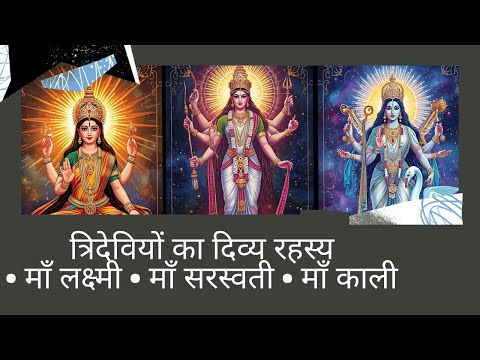
Why is Goddess Lakshmi Saraswati given only one day but Goddess Durga gets nine days?
The Leela
In the sacred city of Maa Shakti, nestled in the lap of Maa Kali, a group of devotees gathered for satsang after a divine darshan at Kali Ghat. The atmosphere was thick with devotion, and the air vibrated with the presence of the Mother. Amidst this spiritual fervor, the speaker posed a question that often escapes the casual observer—a query regarding the very structure of our worship.
Why is it, the speaker mused, that Maa Kali, the embodiment of Shakti, is worshipped for nine full days and nights during Navratri, while Maa Lakshmi receives only the day of Laxmi Pujan, and Maa Saraswati is honored solely on Dussehra? It seemed an imbalance, yet in the realm of the Divine, nothing is without profound cause.
To illustrate this deep mystery, the speaker recalled the life of a titan of industry, Dhirubhai Ambani. Here was a man whose wealth ranked among the greatest in the world, a man touched by Maa Lakshmi’s immense grace. Yet, when a grave stroke struck him, paralyzing his body, no amount of fortune could buy back his vitality. The finest doctors and vast riches were helpless because Maa Shakti—the Kriyashakti, the power of action and health—had withdrawn her hand.
It was a somber realization for those listening: without the foundation of Shakti, the palaces of Wealth (Lakshmi) and Knowledge (Saraswati) crumble instantly. The narrative shifted from the external worship of the Goddess to the internal temple of the devotee, emphasizing that the true blessing lies not in power itself, but in the purity to wield it.
? The Conflict / Doubt
Why does the spiritual calendar dedicate nine entire days to Maa Shakti (Kali/Durga), while the goddesses of Wealth (Lakshmi) and Knowledge (Saraswati) are worshipped for only a single day each?
Is this merely tradition, or does it signify a fundamental spiritual hierarchy necessary for human existence?
The Revelation
The disparity in worship duration reveals the hierarchy of human needs and spiritual evolution. Maa Shakti is the bedrock upon which life stands.
-
The Foundation of Existence: Maa Shakti represents Kriyashakti (the power of action) and vital health. Without this energy, the body cannot function. As the speaker noted through the example of the late industrialist, even boundless wealth holds no value if the body is devoid of life-force. Neither Lakshmi (Wealth) nor Saraswati (Knowledge) can be enjoyed or utilized without the health bestowed by Maa Kali.
-
The Interdependence of Powers: A grand palace endures only if its foundation is unshakeable. Similarly, the intellectual and material achievements of a person are sustained only by their vital energy. If Shakti withdraws, all other attainments become void.
-
The Necessity of Purity (Chitta Shuddhi): The most profound insight is the danger of receiving power before purity. If one possesses health, wealth, or knowledge while the mind remains impure, these gifts will inevitably be misused, leading to self-destruction.
-
The True Prayer: The ultimate spiritual stance is to ask the Divine Mother for sanctity before strength.
"O Mother, if you truly wish to bless me, first sanctify my mind, purify my being, and then pour forth your boundless blessings."
Scriptural References
📖 Devi Mahatmyam / Durga Saptashati ("Ya Devi sarvabhuteshu shakti rupena samsthita"); Shri Sai Satcharita.
Watch the Discourse
In the sacred city of Maa Shakti, nestled in the lap of Maa Kali, a group of devotees gathered for satsang after a divine darshan at Kali Ghat. The atmosphere was thick with devotion, and the air vibr...
Leela Narration
In the sacred city of Maa Shakti, nestled in the lap of Maa Kali, a group of devotees gathered for satsang after a divine darshan at Kali Ghat. The atmosphere was thick with devotion, and the air vibr...