
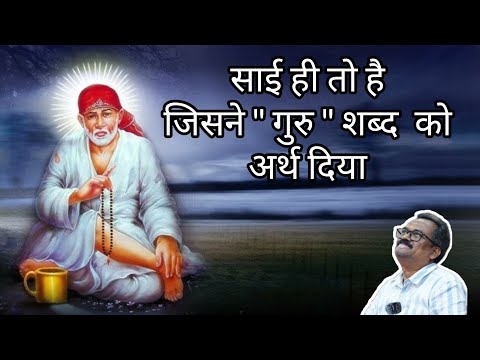
It Is Sai Who Gave Meaning To The Word 'Guru'
The Leela
In the sacred chronicle of Shirdi, there arrived a learned scholar named Muley Shastri from Nasik. He was a devout Brahmin, deeply versed in the Vedas and rigorously devoted to the Agnihotra (fire rituals). His life was governed by strict adherence to purity and scriptural study. However, alongside his devotion lay a subtle rigidity—a belief that sanctity was confined to specific rituals and attires. He was also an expert in palmistry and intended to examine Baba’s hand, thinking, 'If I get hold of his hand, I will study the lines to see what makes this being an avatar. I shall treat him as study material.'
But the Master of Shirdi, who reads thoughts before they are spoken, denied him this intellectual indulgence. Instead of offering His palm, Baba handed him four bananas and dismissed him. Later, as the midday Aarti approached, Baba commanded, "Go get Dakshina from that rigid Brahmin." Muley Shastri, then dressed in his sacred sovala (pure ritual silk), was hesitant. He thought, 'I am a pure Brahmin; if I enter the mosque in these clothes, I will be polluted.' Yet, unable to refuse the wealthy Bapusaheb Booty who brought the message, he walked to Dwarkamai but remained standing in the sabha mandap below, refusing to climb the steps to preserve his ritual purity.
As the Mantra Pushpanjali began, Muley Shastri threw flowers toward Baba from a distance. But in that moment, the veil of illusion lifted. Where Sai Baba sat, Muley Shastri suddenly saw his own late Guru, Gholap Swami—dressed in saffron robes, holding his staff, exactly as he was in life. Overwhelmed with emotion and forgetting all rules of pollution, he rushed up the steps and fell at the feet of the Master, tears streaming down his face. When he opened his eyes, he saw Sai Baba again. Through this divine play, Baba silently taught him that the Guru principle is one. The form may change, but the Spirit is universal.
? The Conflict / Doubt
How can a true Master guide a disciple who belongs to another sect, and does adherence to one's specific religious path prevent reverence for a Universal Guru?
The conflict arises from the human tendency to limit the Divine through duality—creating rigid boundaries of 'my religion' versus 'your religion,' or 'my Guru' versus 'yours.' Muley Shastri believed his purity as an orthodox Brahmin was incompatible with entering a mosque, questioning the authority of Sai Baba over him.
The Revelation
Sai Baba revealed that a true Sadguru stands at the summit of spiritual realization, where all sectarian divisions dissolve. Just as the sky and sun belong to no single individual, the True Guru belongs to the entire universe.
- The Summit Perspective: Baba explains that while we are limited by our vision (seeing only the house in front of us), the Master stands on the mountain peak, seeing the entire city as one. From this height, there is no 'mine' or 'yours,' only the singular experience of Parabrahma.
- Strengthening Faith, Not Converting: Unlike ordinary teachers who try to poach disciples, a True Guru strengthens the devotee's faith in their own path. When Muley Shastri saw Gholap Swami in Baba, his devotion to his original Guru was solidified, not replaced.
- The Magnet and the Iron: Baba declared that regardless of a devotee's impurities or rigidities, once they enter His orbit, they are drawn in.
"That inert iron—I am the lodestone. I have that magnetic power; no matter how inert the iron, Once it comes into my gaze, it is drawn."
- Respect for All, Faith in One: The ultimate teaching is to maintain firm, unwavering faith (Nishtha) in one's own Guru while harboring deep respect for all others. As Baba warned Nana Saheb Chandorkar when he forced a relative to skip a Datta temple:
"You didn't let Biniwale take darshan of his adored one... That's why this time only a thorn pricked. Next time if you do such a thing, I'll hurl a trident."
Scriptural References
📖 Shri Sai Satcharita: Chapter 12 (Story of Muley Shastri, Verses 176 & 178); Chapter 26 (Story of Bhakta Pant); Chapter 38 (Nana Saheb Chandorkar); Chapter 45 (Verse 119).
Watch the Discourse
In the sacred chronicle of Shirdi, there arrived a learned scholar named Muley Shastri from Nasik. He was a devout Brahmin, deeply versed in the Vedas and rigorously devoted to the Agnihotra (fire rit...
Leela Narration
In the sacred chronicle of Shirdi, there arrived a learned scholar named Muley Shastri from Nasik. He was a devout Brahmin, deeply versed in the Vedas and rigorously devoted to the Agnihotra (fire rit...