
The Living Word: The Divine Descent of the Sai Satcharitra
The Leela
In the year 1910, Govind Raghunath Dabholkar, lovingly known as Hemadpant, approached the steps of the Masjid Mai with a burning desire. He sought permission to chronicle the life of the Sage of Shirdi. But writing the biography of a Divine Incarnation is no ordinary feat. Sai Baba looked at him and laid down a condition that would take a tapasya (austerity) of twelve years to fulfill:
"You will write My scripture? First, surrender your ego at My feet. Make your sense of doership absolutely zero. The day you become free of ego, I will enter into you and write My scripture through you."
Time passed. In 1918, Baba took Mahasamadhi, leaving His physical frame. Yet, the scripture had not begun. It was only in 1922, four years after Baba’s physical departure, that the inspiration finally flowed. Why the delay? Baba was cleansing His instrument. For those four years, Hemadpant was purified until not a trace of 'self' remained. Then, Baba descended into the heart of His devotee, turning him into a mere pen.
Chapter by chapter, the divine work unfolded, culminating on November 26, 1930. On this sacred day, exactly eight years after the writing began, the Vāṅgmaya Mūrti—the Living Image of Baba in the form of words—was placed into the hands of humanity. It was not just a book; it was the resurrection of the Sadguru in a form that would never perish.
? The Conflict / Doubt
We proclaim Sai Baba as our Sadguru, yet we often treat Him merely as a deity to fulfill our personal desires, imposing our will upon His idols rather than seeking to know His divine command.
The Revelation
The speaker reveals that the Sai Satcharitra is not a biography but the living, breathing form of Sai Baba Himself. To read it is to engage directly with the Master.
-
The Eight-Year-Old Incarnation: In Chapter 43, Baba prophesied, "I will again incarnate in the form of an eight-year-old child." This does not refer to a human boy, but to the scripture itself, which took exactly eight years (1922–1930) to manifest. It is the eternal child form of the Guru.
-
The Temple of the Word: Just as the Golden Temple in Amritsar enshrines the Guru Granth Sahib as the living Guru, the Sai Satcharitra is the true temple of Sai. Baba declared, "Wherever this scripture is read, I stand there in My living form." Idols in stone temples are memorials where we often project our own egoic desires ("Baba, do this," "Don't do that"). The scripture is where His Will speaks to us.
-
The Test of True Service: A profound parable of Gondavlekar Maharaj illustrates this truth. A simple farmer, who visited the saint only once a year but lived strictly by his Guru's command, attained liberation. Meanwhile, an attendant who served the saint day and night for twelve years remained empty-handed. Why? Because the attendant served according to his own will, while the farmer surrendered to the Guru’s will.
-
The Call to Pārāyaṇa: To perform Pārāyaṇa is not merely to read words; it is to become one with the text. For those few days, one must cease to exist for the world and exist only for the scripture. As Baba promised:
"When I Myself go to My own abode, this scripture will become My image... Call this scripture My true temple—My real memorial."
Scriptural References
📖 Sai Satcharitra Chapter 21, Chapter 27 (v.56), Chapter 35, Chapter 43, Chapter 45 (v.9), Chapter 53 (v.171-172)
Watch the Discourse
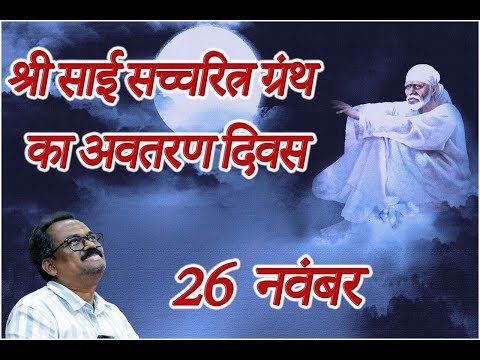
In the year 1910, Govind Raghunath Dabholkar, lovingly known as Hemadpant, approached the steps of the Masjid Mai with a burning desire. He sought permission to chronicle the life of the Sage of Shird...
Leela Narration
In the year 1910, Govind Raghunath Dabholkar, lovingly known as Hemadpant, approached the steps of the Masjid Mai with a burning desire. He sought permission to chronicle the life of the Sage of Shird...